.:[Double Click To][Close]:.
a
a
Showing posts with label advice. Show all posts

Thursday, January 6, 2011

Link: How to talk about cycling with a Conservative

This was sent to me by a liberal friend, and I'm finding it amusing enough, and general enough, to want to share it:
How to talk about cycling with a Conservative

These "across the aisle" arguments have worked for me in the past and, except for continuing to (lightly) include the climate change issue, I think I've largely embraced this more widely accepted set of points, and certainly moved into the national security as related to dependence on foreign oil realm when discussing the global implications of tiny choices at home.

I think my favorite line in the article might be:
"Note: Some business suits actually contain trace amounts of Lycra and Spandex."
Go read the article, you'll see...


Actually I'm wrong, my favorite line is:
"people who choose to ride should be able to do so safely, as taxpaying citizens worthy of full protection of their individual rights to life, liberty and the pursuit of that special kind of happiness one gets from riding a bike."

Amen!


(Note, I looked into the Edison video and it was FILMED by Edison, but he's not actually riding the bike)

Thursday, November 4, 2010

Reflections: Preparing for Darkness


Here is a test photo of my nighttime reflectiveness, as imperfectly demonstrated by a camera flash (rather than a car's headlights). It's easy to see that the wide strips of 3M Scotchlite on my Carradice bag and coat are much more effective than the smaller reflections created by my gloves and the sidewalls of my tires (though those certainly help in correctly identifying my bicycle as such). When riding long distance I add reflective ankle bands, but I usually forget when riding a couple of blocks in town.


Far more effective than reflectiveness is my own light source and you can clearly see that with my unbelievably bright Planet Bike Superflash. They say it can light up a small town. Seriously, this tail light is so bright my husband doesn't like to ride directly behind me. There are two other tail lights in this photo but you're unlikely to notice them. I have the main light and the helmet light blinking (when I'm riding in town) and leave the light on my fender on steadily, just for a change (and because it uses batteries less quickly than the brighter lights).

The clocks fall back this weekend, let's all be ready for the darkness!

Monday, August 16, 2010

A few thoughts on Cyclotouring

I never meant this blog to be about long-distance cycling, and I've tried to keep the posts from being about myself. However today I'm going to forget this policy and, by reader request, share some thoughts and personal experiences regarding long distance cycling.

I actually started riding long distances before I was a transportational cyclist. I was still a city-walker when we lived in Paris, but I bought a road bike to accompany my then-boyfriend on rides out exploring the countryside around Paris. You do need a good bike for this kind of adventure. My first long ride was Paris-Chartres. We extensively used MayQ's routes and advice, all of it is highly recommended, Route #6 will take you to Chartres in about 100km. However I hurt so badly on that first ride thought I was going to DIE.

This is important to remember, and my husband brings it up often. I don't think anyone is born with the ability to go long distances right away. You must build up your endurance, you must build up your saddle seat, you must build up your navigational skills. I'm here to tell you it's worth it, but know that there is a learning curve, start somewhat small, and remember those first rides because you'll look back on them and smile at how far you've come.

I went from that 60 miles or so to doing 250 miles in New Hampshire one day on one occasion and later that summer doing 800+ across France in 8+ days and not even feeling sore. So I can tell you that it can be done. If I can do it you can do it, I find it helps to have a mantra. When I was a wee girl my favorite book was The Little Engine that Could. Now, cycling, I just repeat "I think I can, I think I can". You'll have to find yours.

So we started going further and further and eventually added overnights to the mini-tours. We just do motel-style bike touring, there are some incredible souls who carry tents and stoves on their bikes and I'm certainly not there yet! I learned that if you ask for bike parking you'll be told they have it and it will be a rickety rack in the back of a parking lot. If you call and explain that you have an expensive road bike that can't spend the night outside, but you really want to give the motel your money, they will usually find an acceptable place for the bike, or direct you to a nearby motel that will work. This approach has worked in the USA and France, I imagine it will work just about anywhere. When in doubt just sneak your bike in. If you leave no grease (and you really shouldn't) they'll never know anyway.
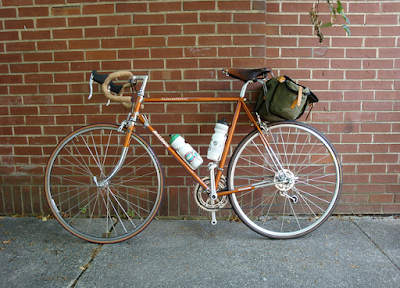
Nelson Longflap Carradice on Raleigh
Going away for overnights and longer adds the complexity of packing for the trip, so let's talk about bike bags and minimalist packing strategies. On my lovely Raleigh International I ride with a Carradice Nelson Longflap (with a Bagman) for touring. I've used it stretched to capacity with everything I needed for a 10 day trip (including a bottle of wine made by our friend's father) and I can't really imagine ever getting a larger bag. I suppose if I ever wanted to tour in a cold climate I might need more space. Anyway, I have modified the attachment system on my bag to allow me to take it on and off the bike. This is particularly important if you're visiting towns and parking the bike on the street. The steps I took were as follows:
  1. visit hardware store. Find flat-bottomed hooks that have narrow enough hook parts to fit through your Brooks saddle loops. This may take several iterations, and I have many hooks that DON'T actually work.
  2. pull the Carradice-supplied straps through the attachment holes and push the hooks through instead. Run the straps through the flat portion of the hooks and loop twice around the internal dowel. Fasten once and be happy that you'll never have to fasten that again.
  3. Extra-Credit - take two D-rings and a length of webbing. Sew a short strap and thus fashion yourself a purse strap to carry your Carradice around your destination.
I can take more photos but hopefully these will help convey the idea. Here are the hooks peeking out from the bag:

hooks to attach a Carradice bag
Here's what it looks like on the inside of the bag:

inside the modified Carradice bag
Here's the bag with the "purse" strap attached, ready to be carried around while your bike is parked:

Carradice Nelson longflap with shoulder strap
Finally, here's a closeup of the photo above where you can see the hooks attaching the bag to the Brooks saddle, the "purse" strap is stowed inside:
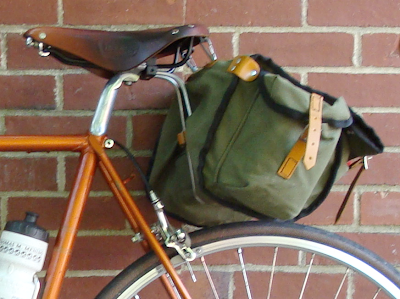
Carradice hooked to Brooks saddle

Now all of this can be avoided if, like my husband, you get their "Seatpost Quick Release" (SQR) bags. I didn't care as much for the look, and the mounting bracket won't work on my Campagnolo aero seatpost (and that is a thing of beauty) so this was my only option.

Once you have your bag ready for touring you have to fill it. We have a team list and then personal lists. Things that the team needs include (in no particular order):
  • sunscreen
  • sunglasses
  • toiletries
  • map(s)
  • lights
  • cash, credit cards
  • cell phones, camera
  • bike lock
  • riding clothes
  • civilian clothes/pyjamas
  • saddle cover and rain gear
  • snacks, water
  • tools, tubes, pump
Note that this list should logically expand, lights would include batteries to make those lights work, etc. Also, while we both need sunglasses only I need to bring regular eyeglasses so those we logically file under "toiletries" and my husband doesn't worry about them. You'll work out your own system but this is what works for us.

As for my personal packing here's all I took on a long weekend trip last year (dubbed 4 States, 4 days, 400 miles):

packing photo bicycle tripIn this photo you can see my bag and helmet, both with taillights, a bag of toiletries, a jersey and bike shorts and overskirt, rain coat, arm warmers, gloves and socks, my long black jersey dress, cycling shoes, grey tights for early morning/late night warmth, a wallet I modified into handlebar-mounted camera case, the purse strap, my cell phone, wet wipes, headlight and sunglasses with extra lenses. Not pictured are my underwear because, while I want to help other aspiring cyclotourists, nothing will compel me to post photos of my underwear on the internet. But don't forget yours!
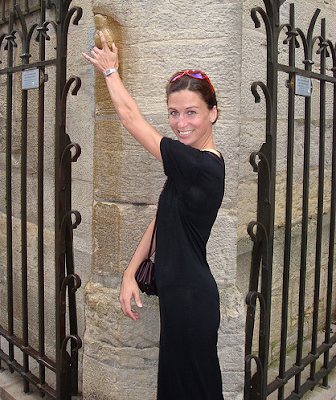
simple dress works for cyclotouring
A word about my jersey dress - this was one of several black jersey dresses I picked up in college, and I wish I remember where! It's light, very drape-y, will not wrinkle, is comfortable to sleep in but can dress up to look completely elegant. I wore it with a black shrug out in France and Madame at our bed & breakfast was astounded at how elegant we looked. She couldn't believe we had that in our little bike bags! If it impresses a former Parisienne then it's good enough for me. I like looking like a relatively normal person for the non-cycling portion of the adventure. I don't know what the equivalent garment will be for you, but I'm certain there is a low-fuss simple option that's probably already in your closet.

When touring far from home you're faced with the question of transporting your own bike or renting one there. I think there are two questions to ask yourself:
  1. Am I a standard size in the place I'm going and are they likely to have a bike that is comfortable for me?
  2. How long will we be riding? Will there be enough vacation off the bike that having it around will be a hassle?
You'll have to work these questions out for yourself, but for our 8 day trip we brought our own bikes. This is no small task! We got cardboard bike boxes from the local bike shop (free) and pipe insulation from the hardware store (~$5/bike). We wrapped the tubes of our bikes in the pipe insulation and wrapped all the components in bubble wrap and clothing. The story is better told in person, but there were all these miraculous circumstances that ended up allowing me to have an old skateboard cut so we had a platform, trucks, and wheels for each bike box. When we got to CDG we pulled out the wheels and duct tape and added them to the back end of our boxes. We could then pull them to the RER and through the streets of Paris. We were lucky enough to have friends willing to store our boxes while we travelled, so we just reversed the procedure to go home. I believe that some hotels have basements where they would do the same thing.

skateboard wheels on a bike box
I can tell you that our homemade solution got a lot of attention in the streets and airport. I thought people were irritated by our large size until I overheard an American family exclaim "Oh! It has wheels!" I guess the wheels are small enough it looked like it was levitating.
Anyway, hurray for Yankee ingenuity, this worked very well for very little cost.
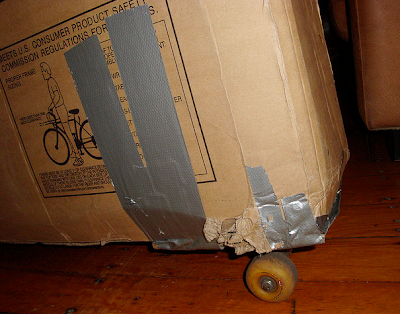
skateboard wheels on a bike box
By the time we were back home in Boston the cardboard had gotten a bit mushy. If you travel much longer than that you might want to reinforce, or actually get a real travel box.

So why bother with all this? If you've read all this text you probably already have the itch to get out there and see the world at the speed of a bicycle. In my experience I've found that you see things, smell things, taste and eat things that you never would have encountered sealed away in a car. People, particularly men of a certain age, just love to come and talk to you about your bike. I've made friends around the world this way. In my case, more than anything, it's been a wonderful adventure with my husband, a microcosm of our more general journey together which has given us new communication channels, appreciation for each other's skills and strength, and a rich set of shared experiences to enjoy even in the midst of the less exciting daily life. It's like therapy, I suppose, but a LOT more fun! So much fun that we spend our time thinking about getting out there again. Where to next? We're planning the next big adventure for September...

In the meantime, happy adventures to all!

adventures by bike

Monday, August 2, 2010

New Bike for a Friend

I get the fun job of helping a friend shop for a new city bike. She's mother to two, so the bike must carry the 18 month old, and in this case reliability trumps aesthetics. I'd still like to find her something cute, and regular readers know I'm a bit out of my element when it comes to new bike shopping, I'm a vintage bike kind of girl. But as I adjusted my brakes yet again this morning I knew that I should limit this bike search to new bikes. I thought I'd list my thoughts and hope that you, dear readers, could chime in with ideas and suggestions.

My friend is about 5'7", a very fit triathlete, with two young girls (4 years and 18 months) who are also growing up to be cyclists. Her previous city bike was a generic hybrid, which was stolen off her fenced back patio! This bike will have to go in the same spot, but we hope to have it better secured. She has a triathlon bike, this should be her upright kid-hauling city bike.

Loop frame ANT with lavender rims
1) dream bike would, of course, be a custom ANT ($2,700)
Upside would be that it would be perfect for her and her family, now and in the future. Downside would be the price. But look at those lines! The headlight! These lavender rims! And working with Mike is so fun. I love the upgrades he has planned... Sigh... It's fun to dream about the custom colors I would choose.

Electra bicycle
2) REI offers the Electra Ticino ($800), onto which I imagine we could add a chainguard. This bike looks a lot like mine, which may be why I like it, but it has cantilever brakes, which appeal to me for kid-carrying. She'd also get the REI refund on the purchase.
Downsides include no eyelets for a rear rack (and thus no baby seat). This is a deal-breaker Electra!

Public mixte
3) A new maker, Public, offers a cute Mixte ($750)
My friend would love the color options, it has a chainguard, and internal hubs ($890 if she needs the 8 speed). There are eyelets for the child seat. As people have commented on this blog, the fender line shown on their website bodes poorly for their overall attention to detail, but we can hope that was just the poor work of the bike stylist?

Lovely Bicycle KHS green
(Photo credit to the excellent blog Lovely Bicycle, who steps in where bike manufacturers fail!)
4) KHS offers the Green bicycle ($350) in black only.
I think the biggest downside to this bike is that certain parts of it do look really cheap. On the other hand they're some of the parts I'm most likely to change anyway. If we got a sprung black Brooks saddle and a pair of black swept-back handlebars I think it would go from "cheap" to "simple little black bike" pretty quickly. I don't believe the included rack is rated to carry a baby seat, so we'd have to switch that out. Also the ladies' bike only comes in 14" and 17" frame sizes. She might fit on a 17" but I know I wouldn't! I do like the idea of an internal hub for her, but while I'm ok with 3 speeds and a rack of groceries, I don't know about three speeds and a rack of toddler. She may need more gearing options. This bike works well for some but definitely has some drawbacks.

Belleville Trek bike
5) Trek offers the Belleville WSD ($660)
It has the 3 speed internal hub, includes the chainguard and fenders and racks. The front rack would likely be very useful to my friend, the rear rack would again probably have to be changed for the baby seat rack. Somehow there's something about this bike aesthetically that I don't like - has it got too much going on or something? Maybe it's that saddle.

Gary Fisher city bike
6) Gary Fisher has the Simple City 3 ($600)
I can't put my finger on it but this bike (and the 8 speed) does not excite me at all, and the women's version is worse.

red Specialized Mixte
7) Specialized Globe has a beautiful candy apple red Live 1 Mixte ($580) but I think my friend needs some gearing. Otherwise I think this bike has a lot going for it, particularly for taller ladies.


So readers, are there any new bikes out there that are exciting, and meet my friend's needs? Should I start looking into vintage bikes with new components (à la Renaissance Bicycles?) How can a lady haul toddlers in style?

Thursday, May 27, 2010

Lazy Woman's Hub Cleaning Scheme

A simple pipecleaner, $1.99 for 100 at my local store (and yes, I have spare ones for free if you want one), makes an excellent hub cleaner for lazy people. The directions are simple:
  1. Wrap it around your hub
  2. Twist the ends together
  3. Forget about it for about a week on your townie or for a long (dry) ride on your pleasure bike
When your hub looks sufficiently clean you just tug firmly to remove. It is so easy that while the rest of my bike is still dirty the hubs are certainly gleaming!

Wednesday, January 13, 2010

Wheel Building Advice Needed


You all know that I have wanted a dynohub for ages. I didn't end up building the SA vintage front hub for a lot of reasons, but that's ok because Santa brought me a Shimano instead!

I am *very* excited.

The remaining challenge is choosing a rim. Here's the scenario I see -
  1. 99% of the time this wheel will be used for commuting in Boston. I look forward to being brighter still during our long winter (I'll keep using my battery light) and I may use the wheel year-round for safety like Velib' and others do. The rear rim I'm using is a Salsa Delgado.
  2. Once or maybe twice a year I will use this wheel on long-distance randonneuring rides. My husband rode his last year for the 400k while I fumbled through with two battery lights (only because his illumination helped, and I don't suggest learning this lesson the way I did), and if I were to do a 600k or even maybe (maybe!) Paris-Brest someday then this wheel will see some distance. The rear rim I'm using on that bike a Mavic Open Pro.

So, what do you wise readers think? Is there a suitable rim that falls between those two uses - sturdy enough for a front wheel year-round commuting, but with enough performance to roll long distances once or twice annually?

Friday, October 2, 2009

Diamond Frame in a Mini Skirt

Last week, leaving work, I was stopped at a red light when a voice issuing from a car behind me politely asked "Excuse me!". I turned and looked and the man in the passenger seat asked "Is that a skirt you're wearing?"

I responded in the affirmative. "On a man's bike?"

Yes, again. "Wow!" he said, "I'm very impressed!"

I hadn't thought much of it before then. Diamond frames are stronger and are made large enough for this tall girl, so that's simply what I ride - in a non-stretch mini skirt or whatever I happen to be wearing. Yes, I have to make some concessions while mounting and dismounting and so here they are:

How to ride a diamond frame in a non-stretch mini-skirt
while carrying lots of groceries:


triangle frame man's bike ridden in a skirt
If at all possible, try to mount and dismount to a curb, a parking block, or any other slightly elevated surface. This permits the most elegant approach as you pass more easily over the top bar and then step down to ride off.

triangle frame man's bike ridden in a skirtIf you happen to be somewhere without an elevated surface (and we want to be able to go anywhere ladies!) then all you have to do is lean your bike over sufficiently to get your leg over. There's a bit of a shuffle to get the bike fully vertical, and then you're on your way!

No big deal.

Thursday, January 22, 2009

Bike Makeover #6: Practical is chic?

Sorry to be away so long, it's been one hell of a month. After my father had his crash, a month later he had himself a heart attack. They performed open-heart surgery last week, and I've been out in California since my last post, to give him a hug - gently.

Naturally, after all that he's got a new lease on life, a new mission, and a plan to ride his bike!

I tried to talk him into a new-old bike, but he loves his vintage Hard Rock, all 4,000 pounds of it. Here's the "before" photo, the bike in all its cracked-oxidized-plastic pie plate, biopace chainring, funny stem-routed brake cable glory:

before photo vintage Specialized Hard Rock bike
Here's the "after", looking much more like a commuter bike with new grips, a bell, a basket, fenders, lock, rack, grocery pannier, and a tail light. I also lubricated the parts that needed it:


Here's the bike on my test ride across the airfield that is his commute. You can see that the mountain bike isn't a bad choice on this terrain.

test ride Specialized Hard Rock commuter bike loaded basket panniers
Dad's briefcase is in the basket. This was essential as he wasn't going to court with a bike bag, and I knew that changing briefcases back and forth would keep him from using his bike. The bike is so large the 18" basket doesn't look as large as it really is. I tested the grocery rack on the dirt trails with a carton of OJ and a bottle of wine. That's going to work just fine.

Dad promises to update us when his sternum is healed and he starts riding. I can't wait!

Monday, June 16, 2008

Project Update 1: The Wine Box

wine crate bike basket conversion homemade DIY
Over the weekend we began the conversion of the wine box I found in the trash. I have to thank my mother-in-law for her help and ideas, she is really good at these projects. Her house is completely customized to her wishes.

reinforced corners bike basket wine crate conversionAnyway, first step with the DIY wine box bike basket, for any of you interested, is reinforcing the structural integrity because the staples in the box are not meant to last. As she drilled the holes for the screws she said that one staple had already given way. We used some quarter-round wood that she had in the barn, cut down to box-height, and screwed the panels of the box into this stronger wood.

We haven't decided yet about how to preserve the wood. My husband votes for natural aging, my mother-in-law and other friends vote for oil finish, and I just don't know what I can do. The appeal of a simple polyurethane is that I do it once, it's preserved and done, and I don't have to deal with smelly finishes over and over in my tiny apartment thoughout the heat of summer. The husband's advice is sound in that the box isn't going to degrade immediately and so I can wait and decide over time.

Sadly this box isn't written all in French, or from a winery in my hometown in California, or (like JPTwins' box) from the winery of my father. However the box was free, and it does have a cyclist on it. So I like it.

bicyclist wine box bike basket rack

Stay tuned! The next post will show how we plan to attach it so that I can remove it easily while still filled to overflowing with good things to eat.

Tuesday, June 10, 2008

"Be truthful. Keep learning. Keep loving. That’s enough"


This article has already been blogged, but I think it bears repeating, mostly because I think there's a lot more for us here than merely fashion (blasphemous, I know!)

“I don’t like to throw anything away that’s valuable. We’re very careful with gasoline, electricity, water,” he said. “We try to make things last. We’re real conservatives unless you’re talking politics.”


This is a man who has his priorities straight. Riding a bike is just a considered aspect of an overall philosophy. I'm slowly learning something about myself by keeping this blog. Similar to what I realized in my musings on "cycle chic", reading this article has reaffirmed to me that a thoughtful and cohesive philosophy which includes cycling is universally considered fashionable cycling.

Optimal Saddle Height

Once you have the right size frame, the first adjustment you should make is getting your saddle in the right place.

This is mostly a height adjustment, but there is a small amount of movement possible forward and back. Most new cyclists leave their saddles too low, probably to make it easiest to get their feet on the ground quickly. The trouble is that this is not the most powerful way to bike. You work harder and can hurt your back, tire out your legs, etc.

There are plenty of mathematical optimizations to calculate your best saddle height, but most people just approximate it. Here's a quick checklist to get you close to your ideal position:

  1. Your saddle should be completely level. If anything, the pros say to have it slightly nose-up, but I say that's no good, just go for level.
  2. With one pedal at the very bottom of your stroke (6 o'clock) and your heel on the pedal, your knee should be just at the bent side of straight. No reaching for the pedal, but still almost fully extended.

That's it! It's easy and will make a huge difference. Note, you may find you want to raise your handlebars once you raise your saddle. That's a subject for another post.


Photo from carfreedays

Friday, May 23, 2008

Give drivers the opportunity not to hit you

I've mentioned before that I come to cycling from the equestrian sports. When I'd give riding lessons one of the big fears we'd address with new riders was the fear that the horse would step on them. I had to explain, patiently, that horses really don't like to step on anything that feels squishy and you are, all of you, squishy to a horse. Give the horse the option and he will consciously avoid stepping on you.

Turns out cars are much like horses - they really don't want to hit you. In talking to people who don't like bikes in the street, most have finally confessed that their actual objection is a fear that they might accidentally hurt a cyclist. So let's all pay attention and give drivers the cues they need to not run over anything 'squishy'.

Given the Opportunity, they really don’t want to hit me
Written by Jeffrey Ferris
published for free in the Boston Bicycle Reflector

I have counseled numerous cyclists and would-be cyclists with this statement over the years. It is an important belief to have for cycling in traffic. It doesn’t mean you can just go out and be oblivious to traffic, but just the opposite! You must actively give drivers the opportunity to not hit you.

The cyclist must be constantly aware of what is going on around him/her and of what is coming. This allows you to be visible and predictable - not invisible or erratic. If a driver doesn’t see me or know what I am going to do, I am at risk. Being seen can mean wearing bright clothes, lights and reflectors at night. It also means not weaving in and out of traffic and the parking lane. A cyclist riding a clear predictable line lets drivers know both where you are and where you are going. Safe biking is not just passively following the rules, but actively using the three C’s: Courtesy, Cooperation, and Communication. Knowing where the cars are is good for your safety, but drivers knowing that you know where they are is important too.

Courtesy means realizing just because you’re righteously saving the earth in a non-motorized vehicle doesn’t mean car drivers aren’t humans trying to get somewhere too. Respect right-of-way, both yours and the drivers. Understand and respect rules-of-the-road, even when you don’t follow them.

Cooperation – Traffic has a certain flow. When you can work with the flow instead of fighting it, everyone is better off.

Communication is much more than arm signals. Turning your head and looking to make eye contact is essential to establishing understanding with drivers. Sometimes its your turn, sometimes theirs. Also body language - I mean indicating your position on the road, not giving the finger.

Follow the 3 C’s and you will be a safer and more respected cyclist with the majority of drivers. It will also make you more prepared to deal with the distracted drivers and the few jerks who don’t want to deal.

More and Safe Cycling,
Jeffrey Ferris

Monday, May 19, 2008

Helmet Advice

I can't tell you whether to wear one or not - that's up to you. I've already said that my position is that I don't want the regret of not wearing one, should the unthinkable happen and I survive, but barely. So I wear a helmet.

In choosing a helmet it's important to know that ALL helmets in the USA must comply with the same safety standards. The only difference between a $20 and a $100 helmet is things like the air vent design, the harness materials, the aesthetics, etc. Functionally it is required by law to work the same.

So buy the cheapest helmet that you like.

Thursday, May 15, 2008

Signalling your turn

How do you signal a turn?

There are two schools of thought on this. One is the canonical form with a right turn signaled by the left arm extended and the forearm pointing up. The more modern method of signaling has the cyclist pointing in the direction she intends to go.

The benefit of the second system is immediately apparent - it is unambiguous to both cars around and the cyclist who has to remember what signal to make when.

I just came to realize that the signals were developed for old fashioned cars (Model Ts and the like) which weren't as reliable as our cars. If your lights broke in an old car you'd have to use the old-fashioned right turn signal, as the modern one could not be seen.

Now that I understand the reason for the system it all makes more sense, I'm more comfortable in the world, and I'll continue to use the modern hand signals.

Graphic from the Frankenmuth Police Department.

Friday, May 9, 2008

Finding the right saddle

I can't tell you what the best saddle is (Brooks! Brooks!) because only your bum can tell you (Brooks!). I can point you to an excellent article on saddle fit, and excerpt some content, with deepest gratitude to Sheldon:

Everybody wants a comfortable saddle on their bicycle. What is not so obvious is what constitutes a comfortable saddle.

You'll notice that I do call them "saddles," not "seats." There is a reason for this. A "seat" is something you sit on, and is designed to bear essentially your entire weight. Recumbent bicycles have "seats," but conventional upright bicycles have saddles. A saddle is intended to carry some, but not all of your weight. The rest of your weight is mainly carried by your legs, and some by your hands and arms.

A cyclist who is out of cycling shape, from being off a bicycle for a bit, will start out strong, but the legs will tire rapidly. When the legs tire, the rider sits harder on the saddle, and that's when the trouble starts. Many saddle complaints are actually traceable to fatigue caused by starting out the season with a longer ride than you are ready for.

Hard or Soft?

When a cyclist finds a saddle uncomfortable, the first impulse is often to look for a soft one. This is often a mistake. Just as the softest mattress is not necessarily the most comfortable to sleep on, the softest saddle is not the most comfortable to cycle on.

Imagine sitting down on a coffee table. Your weight is concentrated on the two bumps of your "sit bones", also known as the "ischial tuberosities." These are the parts of your body designed to bear your seated weight. Most cases of saddle-related discomfort arise because the load is carried on the soft tissues between the sit bones.

Imagine placing a soft pillow on top of the coffee table. Now, as you sit down on it, the sit bones compress the pillow, which yields until the sit bones are almost on the table surface again. The difference is that now, you have pressure in between your sit bones from the middle part of the pillow.

Many cyclists are unaware of this, and many saddles are made to appeal to the purchaser who chooses a saddle on the basis of how easily the thumb can sink into the squishy top. This type of saddle is only comfortable for very short rides, (though an inexperienced cyclist will often find it more comfortable than a better saddle, as long as rides don't exceed a mile or two). Saddles with excessive padding are also a common cause of painful chafing of the inner thigh, as rides become longer.

OK, so you want a minimalist saddle which is just wide enough to support your sit bones.

Most saddles are designed for men, not for women. Due to the wider hips of most women, this can result in the sit bones overhanging a narrow saddle, leading to painful pressure on soft tissues.

In general, women's saddles are somewhat wider and somewhat shorter than those that work best for men. Some newer women's saddles have a large cutout in the middle to eliminate pressure on soft tissues. These work well for many women, but some riders find the sharp-ish edges of the hole irritating.

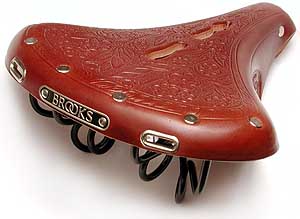
My solution is a tensioned leather saddle (Brooks!):

Until the mid 1970s, most good quality bicycles came with tensioned leather saddles. These have a frame basically similar to that of the padded plastic saddle. A thick piece of leather is rivetted to the bridge, and to an adjustable fitting at the nose of the saddle. The leather is suspended sort of like a hammock.

A properly shaped leather saddle is an excellent choice for the high-mileage rider who doesn't mind the fact that it is a bit heavier than a plastic saddle.

Leather saddles provide "give" by stretching and flexing, without the need for foam padding. The lack of foam greatly improves comfort in hot weather, as heat and perspiration can "breathe" through the porous leather.

Leather saddles also "break in" to fit the particular shape of the rider, in much the same way as a baseball glove does
(or a fine pair of shoes!). They do require more care than plastic saddles.

I have a Brooks B17 and a Brooks B72. No, you can't have either of them, I love them both. Best of luck finding your perfect saddle!

Friday, April 25, 2008

Accessories for a chic commuter

Gotta have the right tool for every job. Here's a list that will keep you in good shape.

A Pump
You will be much happier on your bike if you keep the tires correctly inflated. It is amazing how much of a drag a low tire can be, in addition to putting you at a greater risk of punctures. I keep a pump at my office, because no one sees it under my desk and I have more room here than at home.

A Bike Lock
All locks are vulnerable, consider them only to be a deterrent. There are two general types:
  • Cable lock - intrinsically more flexible, faster to cut through
  • U lock - generally stronger, harder to find suitable locking locations
Only you know which lock will meet your specific needs.

A Tool Kit and Spare Tube
I carry a spare tube, and usually a small pump. On occasions when I don't have the pump I'm relying on a kind cyclist with a pump to stop if I'm distressed, but I'd never expect even the kindest of comrades to give me a tube.

For my minimalist tool set I carry plastic tire irons, regular and Phillips screwdrivers, a small adjustable wrench, and a small Allen set. I don't try to patch a tube while dealing with a commute.

Headlights and Taillights
Lights are legally required after dark in Massachusetts, and a good idea wherever you are, laws or not.

The old-fashioned romantic in me would like to be using dynamo hubs to power my lights, but that hasn't happened for me yet ($$). In the meantime I've been very happy with a rear red blinkie and a handlebar mounted headlight. These run on batteries and are very safe. The handlebar light lives in my bike bag when not on the bike. The rear blinkie is mounted on my helmet, so it is theft-protected as well.

A Helmet
My philosophy on helmets is that they don't hurt and they might help. I don't want to live with the regret of not having done all that I could to stay safe in the unfortunate event of an accident. So I wear one. The only difference between an expensive helmet and a cheap one is how it fits, so buy the cheapest helmet that's comfortable on your head.

Fenders
I love my fenders. I do ride in the rain but I'm more likely to ride right after the rain. My fenders keep the road grime and wet from splashing back up onto me.

A Rack
I have a rear rack on which I clip my bike bag. It also works well for carrying parcels to and from the post office and even bulkier options, like my new living room carpet.

Bags
Almost a requirement, bags which attach to your bike allow you to carry things without having them weigh down your back (and arms, and wrists). You can leave them partially packed with tools and a spare tube. They come in many styles depending on your bike and your needs:
  • Rack bags and panniers
  • Handlebar bags
  • Underseat wedges (usually quite small)
There are some lovely bags out there (many profiled on this blog) or you can see the Sartorialist's photo of a woman using her Louis Vuitton as a handlebar bag. Whatever works for you is the perfect bag.

Cycling Clothing
Whatever you happen to be wearing today! (with possible accommodations if you live in a hot climate and your clothes are delicate) Bicycles work just fine with no special clothing.

Friday, April 18, 2008

What you need to know about bike sizes

Have you ever bought a suit? Buying a bike is similar in many ways.

You know that if the suit fits well across your shoulders then you're good to go. You can make adjustments: shorten the sleeves, nip in the waist, etc. Bikes are the same way - once you get close to the right size they're infinitely adjustable.

The fundamental measurement in a bike is the length of the seat tube. This is the tube that goes from the pedals to your seat post (and saddle). The effective length here can be slightly adjusted by moving your saddle up and down, but fundamentally the seat tube is the "size" of the bike. As a convention road bikes list this size in centimeters, mountain bikes and old three-speeds list the size in inches.

A good way to get your bike size is to go to a good bike store and ask for help. However some bike stores want to put you on whatever stock they have on hand, and some cyclists prefer to reduce/reuse/recycle by buying used bikes. In support of that I offer some basic guidance on getting to your size:

Colorado Cyclist offers a calculator to help you find your ideal frame size. I will qualify there are a couple caveats:
  1. This is intended for sport cycling, generally a city cyclist will want a slightly smaller bike with a more upright position.
  2. It is based on men's measurements. Women tend to have longer legs and shorter torsos so your leg measurement alone will tend to put you on a slightly larger bike.

You might round their measurement down. Their calculator puts me on a 57cm frame, my actual commuter is a 56cm and I would be ok with something even a little bit smaller. So use this to get a measured and calculated idea of your ultimate true size.

The instructions above will be the best way to get your measurement, and the values below should give you some idea of what you'd expect for your result. Actual measurements/calculations are better than this table which I cobbled together from various sources of ambiguous authority from all over the web.


height inseam road mountain old 3 speeds
5'3"28"/71cm49cm14"19"
5'5"30"/76cm51cm16"19"
5'7"31"/79cm53cm17"21"
5'9"33"/84cm56cm18"21"
5'11"34"/89cm60cm19"23"


Once you get the seat tube right you can tailor the bike to fit you perfectly by changing the handlebars and the stem. I'll post on that (with photos of my own bike) soon!

(One more thing: used bike sellers often get confused between TIRE sizes and FRAME sizes - if they claim a bike is 26" or 27" they're probably looking at the tire size)

Monday, April 14, 2008

Riding tips for new cyclists

Sydney bike girlThis text is modified from the original at Rivendell, to customize for my sister and step-mom and any interested new cyclists.

Fun is more important than fast.

Ride only when you feel like it.

Learn right away that the front brake is the most effective one, and don't brake hard in sand or silty road debris.

Learn how far you can lean over without scraping a pedal and learn to keep the inside pedal UP when you corner.

Be the master and commander of your own bicycle. Learn to fix a flat. Never let your chain squeak. That is why you need chain lubricant, $5.

Get a bell. Signal your approach to pedestrians, especially if they're old. A bell is better than "On your left!" but it will do if you're bell-less.

Never hit a pedestrian. In traffic, be visible and predictable.

Don't ride in shoes you can't shop in.

The best bike on earth is the one that you WANT to ride. Feel comfortable mixing high tech and low tech, old and new parts and technologies, and don't apologize to anybody for it. If you buy a new bike, do something to it that makes it the only one exactly like it in the world.

Compliment other people's bikes, especially if they're old and well cared for.

Buy the cheapest helmet that fits well.

Don't always shop by price and never ask for discounts at your local bike shop. Every time you go into a bike shop, spend at least $2, and if you ask a question and get good advice, spend $5 (get a cable).

Never apologize for buying something that's not quite pro quality by saying, "I'm not going to race or anything."

Have at least one bike you feel comfortable riding in a downpour. Ride in weather that keeps other cyclists indoors. ENJOY being outside, even if it's wet/humid/cold/hot/dark...

If you borrow somebody else's bike, for a short test or a long ride, say something nice about it.


Photo and Rivendell tip inspiration taken from Sydney Body Art Ride blog. Thank you!

Tuesday, March 11, 2008

Lock your bike

You know you need to lock your bike. But how? It is true that there is a right way and a wrong way.

Sheldon Brown's advice on locking your bike should be required reading for all bike commuters.

I have a keycode-access shed at work and a locked shed at home, so I just need to carry an ordinary cable lock for quick stops. I have a boring black lock but I can't help but think that there must be something better!

Here is one option: For the lightweight cable lock that one carries all the time, these French snake locks are fun (if you can stand snakes!) The snake is available in many colors to complement your bike.