In 1208 Chinggis Khan defeated the Naiman, and captured their Uyghur scribe Tatar-Tonga, who apparently adapted the Old Uyghur alphabet to write Mongolian. The alphabet created by Tatar-Tonga is now known as the Uighur/Uyghur Script, the Classical Mongol Script, the Old Script, or Mongol Bichig in Mongolian.
Between the 13th and 15th Centuries, Mongolian was also written with Chinese characters, the Arabic alphabet and a script derived from Tibetan called Phags-pa.
As a result of pressure from the Soviet Union, Mongolia adopted the Latin alphabet in 1931 and the Cyrillic alphabet in 1937. In 1941 the Mongolian government passed a law to abolish the Classical Mongol script, but since 1994 they have been trying to bring it back. It is now taught to some extent in schools, though is mainly used for decorative purposes by artists, designers, calligraphers and poets. The average person in Mongolia knows little or nothing about the Classical Mongol script, though there is high literacy in Cyrillic. In Inner Mongolian Autonomous Region of China the Classical Mongol script is still used.


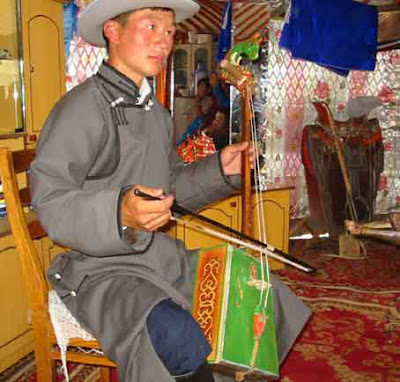
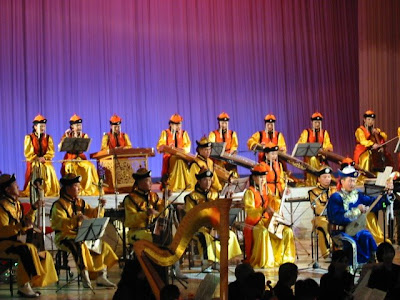
 The underhand grip enables the hand to tighten the loose hair of the bow, allowing very fine control of the instrument's timbre. The larger of the two strings (the "male" string) has 130 hairs from a stallion's tail, while the "female" string has 105 hairs from a mare's tail. Traditionally, the strings were tuned a fifth apart, though in modern music they are more often tuned a fourth apart. The strings are stopped either by pinching them in the joints of the index and middle fingers, or by pinching them between the nail of the little finger and the pad of the ring finger. Traditionally, the frame would have been covered with camel, goat, or sheep skin, in which case a small opening would be left in back, but in modern times, an all-wood sound box is more common, in a style similar to European stringed instruments, including the carved f-holes. Morin khuur vary in form depending on region. The Instruments from central Mongolia tend to have larger bodies and thus possess more volume than the smaller-bodied instruments of Inner Mongolia. The morin khuur is one of the Masterpieces of the Oral and Intangible Heritage of Humanity identified by UNESCO.